After the Egg Breaks: Conservation Districts, Grief, and the Work of Living in a Broken World
2025
“Perhaps our most important work is learning to live inside the brokenness in ways that generate wholeness, not as a return, but as a renewal.”
After the Egg Breaks reimagines the Humpty Dumpty tale as a lens for understanding ecological grief and the limits of technical fixes. Written to encourage conservation professionals, especially within the habitat restoration realm, like myself, to grapple with loss and uncertainty, and encourage an examination of the inner realms that are often not discussed. The essay blends storytelling, psychology, Integral theory, and ecological insight to illuminate how communities and conservation professionals can posture toward the difficulties frequently faced and reorganize around what other realms can be restored, if not the ecological one.
Medium / Project Type
Skills Used
Toolkit
Creative Writing
After the Egg Breaks: Conservation Districts, Grief, and the Work of Living in a Broken World
We’ve all heard the story. It goes something like this:
“Humpty Dumpty sat on a wall.
Humpty Dumpty had a great fall.
All the King’s horses and all the King’s men
Couldn’t put Humpty together again.”
It’s curious, isn’t it? That such a strange, frumpy anthropomorphic egg, precariously perched on a wall, would merit the immediate attention of the kingdom’s finest. The King’s horses. The King’s men. The smartest. The bravest. The most noble.
And still…
They couldn’t fix him.
Imagine: the rush of hooves, the jangle of armor, the dust rising as they arrive at the site of Humpty’s fall. There he is, yolk seeping into the dirt, his cracked shell spread like a broken mosaic. A stunned expression frozen on what once passed as a face. The horses lean in, curious or hungry. The men panic, grasping at the pieces, as the sutures are not holding, collecting what they can in buckets, but it spoils faster than it’s saved. Nothing works. Every tool they brought was useless. Every effort, too late.
And then that dreadful stillness…when it becomes clear:
He’s not coming back.
You have to ask: why this egg? Why such an outpouring of response for such a peculiar figure?
Maybe Humpty was the town eccentric – an oddity, yes, but theirs. The beloved misfit who gave the village its edge, its personality, its story. The kind of character townsfolk fretted about quietly, but would fiercely defend if mocked by outsiders. Maybe he was the silent friend of children on their way to school, always nodding, always warm. Perhaps he made people feel seen. Maybe he made them feel safe.
What’s clear is that Humpty mattered.
And now, there’s nothing left to do but stand over the loss. Still hoping. Still searching for a way to undo what’s been done. But there is no putting Humpty Dumpty back together again.
We’ve been here before.
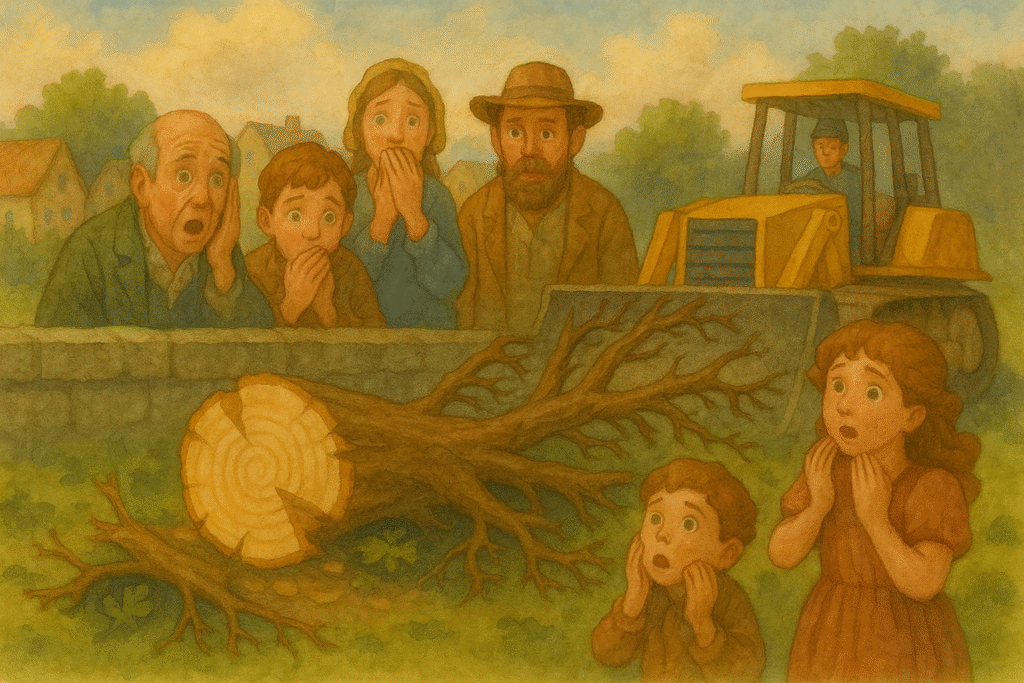
The tree you looked forward to seeing on your commute, bulldozed for development. The sunrise view, swallowed by smoke or skyline. A species, once common, now untraceable. A wetland renamed “retention.” A stream entombed in concrete. A field where fog would rest. A ranch wiped away. The world, piece by piece, scrambled.
And always nearby: the conservationists. The scientists, the policy-makers, the hopeful and heartbroken. Watching Humpty fall again and again, trying to hold the pieces.
We stand over this broken land. What now?
Often, we do what we’ve been trained to do: We deploy studies, pilot programs, revise policies. We channel federal dollars into action, metrics, progress. It’s valiant. It’s sacred. It’s needed.
And what of everyone else standing around Humpty? The community.
The people who loved him, worried about him, laughed with him, and needed him. The ones who felt safer with him there. What are they feeling?
A place now a little less whole.
A story with a sudden silence where a character used to be.
Grief. Loss.
But where is the space for that grief? Organizations pride themselves on solutions – on moving forward, staying productive, proving relevance. RCDs are no exception. We celebrate impact, metrics, projects completed.
Yet the most essential task, the one quietly missing, culturally atrophied, is grieving.
The kind of grief I mean metabolizes loss. It doesn’t freeze or fix. It digests. But we often eat alone in this grief; silently, bitterly, desperately.
Grief, left undigested, festers into burnout, rage, numbness, hollow victories. Undigested emotion leads to undigested solutions.
The King’s men and horses, bless them, were never meant to fix Humpty. They couldn’t. Their call that day wasn’t to restore a body, but to restore meaning. To sit with the shattered pieces. To bear witness. To help the community speak of what was lost. To make song, ritual, story. To name the sacredness of what had been and what must now become. To midwife the village through sorrow into something whole again.
As Francis Weller writes, “Grief is not a feeling, but a capacity.” It is not weakness. It is not a distraction. It is the ground of transformation. It’s one of the many capacities conservationists must now cultivate, not to replace technical knowledge, but to deepen it. To embed it in the reality of human and ecological complexity. When we allow sorrow to touch us, we touch the depth of our love for this world. And in that mingling, what Weller calls “the wild edge of sorrow”, something softens, something opens.
I wonder:
Can conservationists, who bear daily witness to fragmentation, also become the grief-bearers? Can we stand not only with solutions, but with songs and silence? Can we learn to sit among the broken shells and spilled yolk, with the mourners and watchers?
So the question isn’t: “How do we put it back together again?” It becomes: “How does the system want to reorganize around this loss?” “What now becomes possible, not despite this fall, but because of it?” “What does the Earth want us to become in response to this breaking?”
Perhaps our most important work is learning to live inside the brokenness in ways that generate wholeness, not as a return, but as a renewal.
This is complexity-ready conservation.
Values and Ethos
Grief as a Communal Capacity and Practice
This essay frames grief as necessary shared meaning-making generator and one that is best done in community—especially in the circumstanes of ecological grief and change.
Renewal as a New Take on Restoration
The essay reorients conservation from “putting things back together” to engaging creatively with what now becomes possible; a shift toward generative vision.
Storytelling as Transformation
By retelling a familiar nursery rhyme, the piece allows communities to access complex ecological and emotional truths through metaphor, imagination, and shared language.
Image Attribution: AI-generated illustration created with ChatGPT/DALL·E (OpenAI).